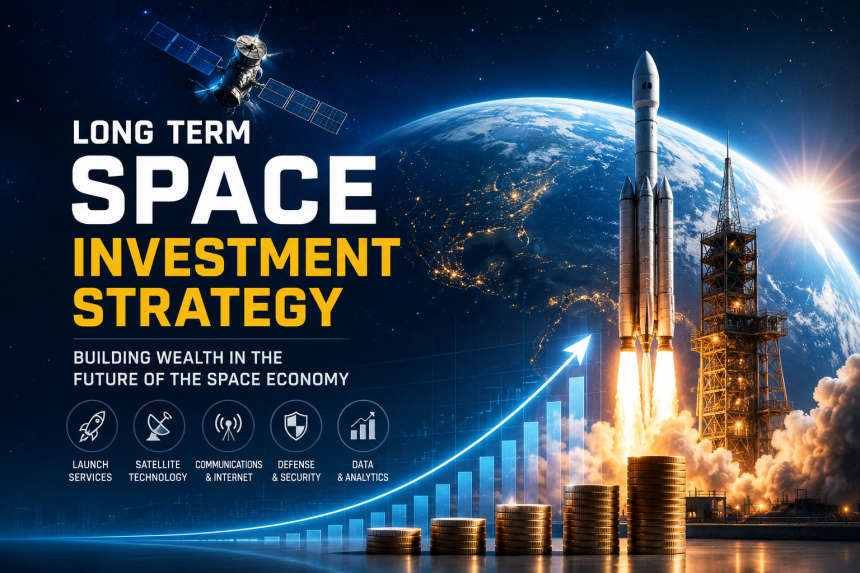
The idea of investing in space is no longer science fiction. It has become a serious financial discussion among investors, governments, and private companies. As technology improves and access to orbit becomes cheaper, the space economy is expanding into communications, defense, exploration, tourism, and resource utilization. A well planned long term space investment strategy can help investors position themselves early in one of the most transformative industries of the century.
This article explains how space investing works, what sectors matter most, and how to think about building a strong, future focused portfolio. It also naturally includes key concepts around space investment strategy and the broader space sector investment opportunities that are shaping global markets.
Understanding the Long Term Space Investment Strategy
A long term space investment strategy focuses on identifying companies, technologies, and infrastructure that will benefit from the growing commercialization of space over decades rather than months or years. Unlike traditional sectors, space is still in a developing phase, meaning volatility is high but so is potential upside.
The strategy is not just about buying stocks of rocket companies. It includes a wide range of industries such as satellite communications, space manufacturing, launch services, defense technology, and even asteroid mining concepts. Investors who think long term are essentially betting on the expansion of human activity beyond Earth’s atmosphere.
The most important mindset shift is patience. Space projects often take years to become profitable. That is why the long term space investment strategy is built around gradual growth, innovation cycles, and government contracts rather than short term speculation.
Why Space Is Becoming a Powerful Investment Sector
The global space economy has been growing rapidly due to private sector innovation. Companies like SpaceX have reduced launch costs significantly, making space more accessible for commercial use. At the same time, satellite demand is increasing due to internet connectivity, GPS services, and Earth observation needs.
One of the biggest drivers of space investment strategy today is satellite based internet. Thousands of low Earth orbit satellites are being deployed to provide global broadband coverage. This creates opportunities for manufacturers, launch providers, and data service companies.
Another factor is defense spending. Governments such as NASA and European Space Agency are investing heavily in space infrastructure for research, communication, and planetary exploration. This creates stable long term contracts for companies involved in aerospace engineering and satellite systems.
Key Areas to Focus on in a Space Investment Strategy
A strong space investment strategy requires understanding different segments of the industry. Each segment plays a role in the overall ecosystem.
1. Launch and Rocket Technology
This includes companies that build rockets and provide launch services. Businesses like Rocket Lab and Boeing are active in this space. These companies are essential because every satellite, space station module, or exploration mission depends on reliable launch systems.
2. Satellite Manufacturing and Services
Satellites are the backbone of modern space usage. Companies in this category design, build, and operate satellite networks used for communication, weather forecasting, navigation, and defense. This segment is considered more stable because satellites generate recurring revenue through long term service contracts.
3. Space Infrastructure and Exploration
This includes space stations, lunar exploration projects, and deep space missions. Governments and private companies are both involved. Over time, projects like lunar bases and orbital stations may become key pillars of the long term space investment strategy.
4. Space Technology and Data Analytics
Space generates massive amounts of data used for agriculture, climate monitoring, disaster management, and urban planning. Companies that process this data are becoming extremely valuable. Artificial intelligence is also being used to analyze satellite imagery, making this segment a fast growing part of the space investment strategy ecosystem.
5. Defense and Aerospace Integration
Many space companies work closely with defense agencies. This creates stable revenue through long term contracts. Defense driven innovation also pushes technology forward, which benefits the entire space economy.
Real World Companies Driving Space Growth
The space sector is no longer theoretical. Several companies are already shaping its future.
Virgin Galactic is focusing on commercial space tourism, offering suborbital flights for civilians. While still early stage, it represents the future of space travel as a consumer experience.
Blue Origin is working on reusable rocket systems and long term human spaceflight infrastructure. These developments are critical for reducing costs and expanding access to space.
Traditional aerospace companies like Boeing and Lockheed Martin also play a major role in government contracts and space missions, adding stability to the industry.
Risks in Long Term Space Investment Strategy
Although the potential is significant, space investing is not without risks.
One major risk is technological failure. Space missions are extremely complex, and even small errors can lead to mission loss and financial setbacks.
Regulatory uncertainty is another challenge. Governments control most space activity, and policy changes can directly affect private companies.
Valuation risk is also important. Many companies in the space sector are priced based on future expectations rather than current profits, which can lead to sharp market fluctuations.
Competition is increasing as well. More companies are entering the market, which may reduce profit margins over time, especially in launch services.
How to Build a Balanced Space Investment Portfolio
A practical long term space investment strategy should be diversified across multiple layers of the space economy.
A balanced portfolio may include:
- Established aerospace companies with stable government contracts
- High growth private space companies
- Satellite communication and data service providers
- Technology firms focused on AI and space analytics
- Defense linked aerospace contractors
Some investors also use ETFs or diversified funds that include space related companies to reduce risk exposure while still participating in industry growth.
Diversification helps manage volatility while maintaining exposure to the long term expansion of the space sector investment ecosystem.
The Role of Innovation in Space Investment Growth
Innovation is the core driver of space investment strategy. Reusable rocket technology has already reduced launch costs significantly, making space missions more affordable.
Satellite miniaturization has also changed the industry. Smaller satellites can now be deployed in large networks, creating global coverage systems at lower cost.
Artificial intelligence is another major innovation. It helps process satellite data faster and more accurately, which is critical for industries like agriculture, logistics, and climate monitoring.
As innovation continues, new opportunities will emerge in space tourism, lunar mining, and interplanetary logistics, all of which could become major components of a long term space investment strategy.
Government Influence and Global Competition
Governments play a major role in shaping the space industry. Agencies like NASA and ESA fund research, exploration, and infrastructure projects. These partnerships provide long term stability for private companies.
At the same time, global competition is accelerating. Countries are competing for leadership in space technology, which is pushing faster innovation and increased funding. This benefits early investors who are already positioned in the space sector investment cycle.
Future Outlook of Space Investment
The future of space investing is highly promising. Over the next few decades, the industry is expected to expand into commercial space travel, lunar bases, asteroid mining, and deep space communication networks.
As costs decrease and technology improves, more private companies will enter the market. This will create a wider and more competitive ecosystem with multiple investment opportunities.
The long term space investment strategy is not about quick gains. It is about understanding the direction of human progress and investing in the infrastructure that supports it.
Conclusion: Thinking Beyond Earth
Space is becoming one of the most important frontiers for innovation and economic growth. Investors who understand these trends early can benefit from long term expansion across multiple industries.
A well researched long term space investment strategy requires patience, diversification, and strong understanding of emerging technologies. As the space economy grows, staying invested in this sector may align investors with one of the most powerful growth stories of the future.
In the end, the success of any long term space investment strategy depends on vision, discipline, and the ability to stay committed to the evolving world of space exploration and space investment strategy.