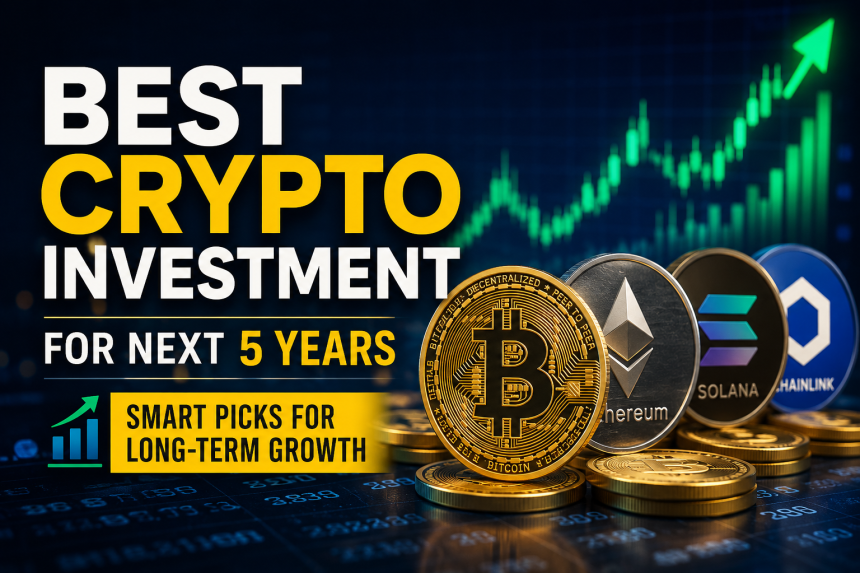
Finding the best crypto investment for next 5 years is not about chasing the coin that is trending today. It is about understanding which digital assets have real utility, strong adoption, long-term demand, and the ability to survive market cycles. Crypto can move fast, and prices can rise or fall sharply, but long-term investors usually look beyond short-term hype and focus on projects with strong fundamentals, active development, and growing use cases.
Cryptocurrency has matured a lot over the past few years. Bitcoin is no longer just discussed by early adopters. Ethereum is not only a crypto token; it powers a major part of decentralized finance, NFTs, stablecoins, and smart contract applications. Other networks like Solana, Chainlink, and selected infrastructure-based projects are also gaining attention because they solve real problems in speed, data, scalability, and blockchain connectivity.
Still, crypto is not a guaranteed path to wealth. It is a high-risk investment class. Prices can be affected by regulation, interest rates, investor sentiment, liquidity, scams, exchange failures, and sudden market crashes. Even large assets like Bitcoin and Ethereum can face deep drawdowns. Recent market reports have shown that crypto still reacts strongly to ETF flows, macroeconomic pressure, and risk-off sentiment in global markets.
That is why the smartest approach is not to ask, “Which coin will make me rich quickly?” A better question is, “Which crypto assets have the strongest chance of staying relevant over the next five years?” This article breaks down the most realistic long-term options, what makes them valuable, and how investors can think about crypto with a safer and more practical mindset.
Best Crypto Investment for Next 5 Years: What Makes a Coin Worth Holding?
Before choosing any cryptocurrency, it is important to understand what gives a crypto asset long-term value. Hype can pump a coin for a few days or weeks, but real value usually comes from utility, security, adoption, liquidity, and trust.
A strong long-term crypto investment should have a clear purpose. Bitcoin, for example, is mainly seen as a decentralized store of value. Ethereum is known for smart contracts and decentralized applications. Chainlink connects blockchain systems with real-world data. Solana focuses on speed and low-cost transactions. Each of these projects has a different role, which is why long-term investors often look at categories instead of only looking at price charts.
Market size also matters. Larger cryptocurrencies usually have better liquidity, wider exchange availability, stronger developer communities, and more institutional interest. Forbes’ 2026 cryptocurrency rankings continue to list Bitcoin, Ethereum, BNB, XRP, Solana, and other large-cap assets among the biggest names by market value and trading activity.
Another important factor is regulation. Governments are paying closer attention to crypto, and clearer rules may help serious projects grow while pushing weaker or risky projects out of the market. In 2026, the SEC also issued statements clarifying how federal securities laws may apply to different types of crypto assets, including staking, mining, stablecoins, digital commodities, and digital securities.
For a five-year investment view, the best crypto is usually not the flashiest coin. It is the one with staying power.
1. Bitcoin: The Strongest Long-Term Foundation
Bitcoin is still the first name that comes to mind when people talk about long-term crypto investing. It has the largest brand recognition, the longest operating history, a fixed maximum supply of 21 million coins, and the strongest position as a digital store of value.
One reason Bitcoin remains attractive is scarcity. Unlike fiat currencies, Bitcoin’s supply schedule is fixed by code. This does not mean the price will always go up, but it does create a long-term investment story around limited supply and growing demand.
Bitcoin also benefits from institutional access. The approval of spot Bitcoin exchange-traded products in the United States in January 2024 made it easier for investors to gain regulated exposure to Bitcoin without directly holding coins on a crypto exchange. This was an important moment because it helped bring Bitcoin closer to traditional financial markets.
However, Bitcoin is still volatile. Even with stronger infrastructure and institutional products, it can drop sharply during weak market conditions. S&P Global has noted that Bitcoin’s volatility has eased over time but remains higher than traditional assets.
For the next five years, Bitcoin may remain the most conservative crypto choice compared with smaller altcoins. It may not always deliver the biggest percentage gains, but it has the strongest survival record and the clearest role in the market.
2. Ethereum: The Long-Term Smart Contract Leader
Ethereum is another strong candidate for long-term crypto investors. While Bitcoin is often compared to digital gold, Ethereum is more like a decentralized technology platform. Developers use Ethereum to build decentralized finance apps, NFT marketplaces, stablecoin systems, tokenized assets, games, and other blockchain-based tools.
Ethereum’s value comes from its network effect. Many developers, users, protocols, and businesses already build on Ethereum. This gives it a strong advantage because blockchain ecosystems become more useful as more people use them.
Ethereum also plays a key role in stablecoins and decentralized finance. Many major stablecoin transactions and DeFi applications are connected to Ethereum or Ethereum-compatible networks. This gives ETH more utility than many coins that exist only for speculation.
The main challenge for Ethereum is competition. Networks like Solana and other layer-1 blockchains offer faster and cheaper transactions. Ethereum has also faced criticism for high fees during busy periods. However, its strong developer base, security, liquidity, and ecosystem size still make it one of the most important crypto assets for the next five years.
For investors looking beyond Bitcoin, Ethereum is often the second major asset to consider. It has more technology risk than Bitcoin, but it also has broader use cases.
3. Solana: A Higher-Risk Growth Option
Solana is often viewed as one of the most promising high-growth blockchain networks. Its main appeal is speed and low transaction costs. This makes it attractive for decentralized apps, payments, trading platforms, gaming, NFTs, and consumer-facing blockchain products.
Solana has built a strong community and continues to attract developers. It is also widely followed by traders and long-term crypto investors because it offers a different value proposition from Ethereum. While Ethereum focuses on security and ecosystem depth, Solana focuses heavily on performance and scalability.
That said, Solana carries more risk than Bitcoin and Ethereum. It has experienced network reliability concerns in the past, and its price can be extremely volatile. It is also competing in a crowded layer-1 market where many projects are trying to become the main blockchain for fast applications.
For the next five years, Solana may appeal to investors who want growth potential and are comfortable with higher risk. It should not be treated as a “safe” crypto investment, but it could remain relevant if it continues to grow its ecosystem and attract real users.
4. Chainlink: A Practical Infrastructure Play
Chainlink is different from Bitcoin, Ethereum, and Solana because it is not trying to be money or a general-purpose blockchain. Instead, it provides oracle infrastructure. In simple terms, Chainlink helps smart contracts access real-world data such as prices, market information, proof of reserves, and other external inputs.
This matters because blockchains cannot naturally read outside data on their own. If decentralized finance, tokenized assets, insurance products, gaming platforms, and real-world asset systems continue to grow, reliable data connections will be important.
Chainlink’s long-term strength comes from its practical role in the blockchain industry. It is less exciting to casual investors than meme coins or trending tokens, but infrastructure projects can become valuable because other systems depend on them.
The risk is that Chainlink’s token value depends on continued adoption and demand for its services. Investors should also understand that a strong project does not always mean guaranteed token price growth. Still, as a five-year infrastructure pick, Chainlink deserves attention.
5. Stablecoins and Tokenization: Not Always for Growth, But Important
Stablecoins are not usually considered growth investments because they are designed to hold a stable value, often linked to the U.S. dollar. However, they are becoming one of the most important parts of the crypto economy. Stablecoins are used for trading, payments, transfers, DeFi, and moving money quickly across blockchain networks.
Tokenization is another major trend. It refers to bringing real-world assets such as bonds, funds, real estate, or commodities onto blockchain systems. This could become a major area of growth over the next five years, but it also comes with risk. The IMF has warned that tokenization could introduce crypto-related volatility and smart contract risks into broader financial markets if not managed properly.
For regular investors, this means the future of crypto may not only be about coins going up in price. It may also be about blockchain becoming part of financial infrastructure. Projects connected to stablecoins, tokenization, security, data, and compliance could become more important over time.
How to Build a Smarter Five-Year Crypto Strategy
A smart crypto strategy should be balanced. Instead of putting all money into one coin, many long-term investors prefer a core-and-satellite approach.
The core could include Bitcoin and Ethereum because they are the most established assets. The satellite portion could include higher-risk projects like Solana, Chainlink, or other carefully researched tokens. This way, the portfolio has exposure to both stability and growth potential.
Another useful method is dollar-cost averaging. This means investing smaller amounts regularly instead of buying everything at once. Since crypto prices move sharply, dollar-cost averaging can reduce the stress of trying to time the perfect entry.
Security is also extremely important. Investors should use trusted exchanges, enable two-factor authentication, avoid suspicious links, and understand wallet safety. In crypto, mistakes can be costly. Sending funds to the wrong address or approving a malicious transaction may lead to permanent loss.
It is also wise to avoid emotional investing. Many beginners buy when prices are already pumping and sell when fear takes over. A five-year mindset requires patience, research, and discipline.
What Crypto Investors Should Avoid
Not every crypto project deserves attention. Some coins are built only on hype, celebrity promotion, or unrealistic promises. Meme coins can sometimes deliver short-term gains, but they are usually very risky for long-term investors.
Investors should be careful with projects that promise guaranteed returns. No legitimate crypto investment can guarantee profit. Be cautious of staking platforms, trading bots, unknown presales, and influencers pushing coins without explaining the risks.
It is also important to avoid overinvesting. Crypto should usually be only one part of a wider financial plan. Stocks, cash, real estate, bonds, business investments, or other assets may also play a role depending on a person’s financial situation.
The goal is not to risk everything for one big win. The goal is to build exposure to a growing industry without destroying financial stability.
Final Thoughts
The best long-term crypto investments are usually the ones with strong fundamentals, clear use cases, deep liquidity, and real adoption. Bitcoin remains the strongest foundation. Ethereum offers exposure to smart contracts and decentralized applications. Solana may provide higher-risk growth potential. Chainlink stands out as an important infrastructure project. Stablecoins and tokenization show how blockchain may become part of everyday finance.
Still, crypto is risky. Prices can fall quickly, regulations can change, and even strong projects can struggle during bear markets. Anyone investing for five years should think carefully, diversify, protect their funds, and avoid chasing hype.
In the end, the best crypto investment for next 5 years may not be one single coin. A thoughtful mix of Bitcoin, Ethereum, and selected utility-driven projects could offer a more balanced way to participate in crypto’s future while managing risk.