Introduction to Quantitative Easing and Its Purpose
Quantitative Easing, often abbreviated as QE, is one of the most influential monetary policy tools used by central banks in modern financial systems. It became widely recognized during periods of economic crisis when traditional interest rate cuts were no longer effective. In simple terms, Quantitative Easing is the process where a central bank creates new money electronically and uses it to purchase financial assets, usually government bonds, from commercial banks and financial institutions.
The main objective of Quantitative Easing is to increase liquidity in the economy. When banks have more cash on hand, they are more likely to lend money to businesses and individuals. This increased lending is intended to stimulate spending, investment, and overall economic growth. It is a tool designed to stabilize economies during periods of recession, low inflation, or financial instability.
How Quantitative Easing Works in Practice
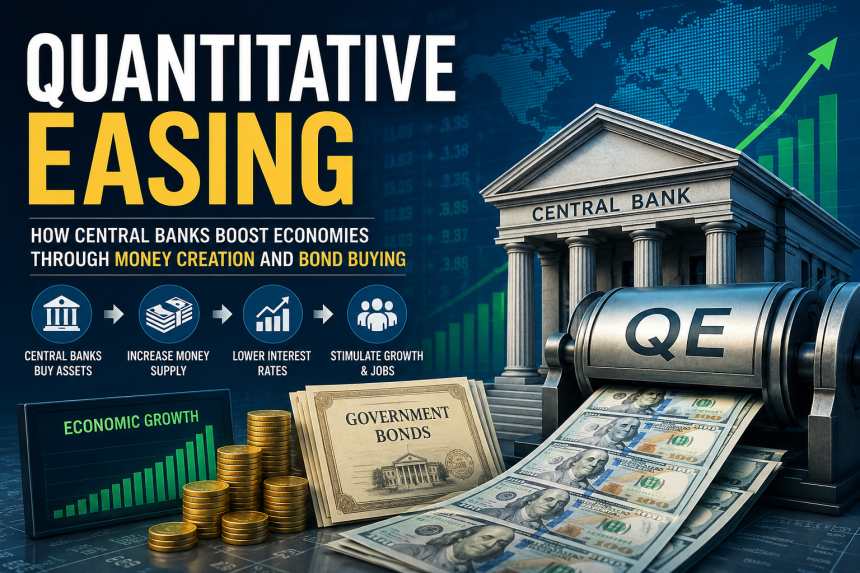
To understand Quantitative Easing, it is important to look at how it functions step by step. A central bank, such as the Federal Reserve, the European Central Bank, or the Bank of England, begins by creating digital money. This money does not come from taxpayers or government revenue. Instead, it is newly created within the central banking system.
Once the money is created, the central bank uses it to purchase government bonds or other financial assets from commercial banks. These bonds are essentially loans made to the government, and by buying them, the central bank injects fresh money into the financial system.
As banks sell these bonds, they receive cash in return. This increases their reserves, making them more willing to lend to businesses and consumers. Ideally, this process lowers borrowing costs, encourages investment, and supports job creation.
Another important effect of Quantitative Easing is its influence on interest rates. By purchasing large quantities of bonds, central banks increase bond prices and reduce yields. Lower yields translate into lower interest rates across the economy, making loans more affordable.
The Role of Central Banks in Quantitative Easing
Central banks play a crucial role in implementing Quantitative Easing. They are responsible for managing monetary policy and ensuring economic stability. During financial crises, central banks often use QE when conventional tools, such as lowering short-term interest rates, are no longer effective because rates are already near zero.
For example, during the global financial crisis of 2008, several major economies introduced Quantitative Easing programs to prevent economic collapse. Similarly, QE was used extensively during the COVID-19 pandemic to support struggling economies and financial markets.
Central banks must carefully balance the benefits and risks of QE. While it can provide immediate economic relief, excessive use can lead to unintended consequences such as asset bubbles or long-term inflationary pressures. This makes Quantitative Easing a powerful but delicate policy tool.
Quantitative Easing and Its Impact on Inflation
One of the most debated aspects of Quantitative Easing is its effect on inflation. Inflation refers to the general increase in prices over time. In theory, increasing the money supply through QE should lead to higher inflation because more money is circulating in the economy.
However, the actual impact is more complex. In some cases, QE has helped central banks prevent deflation, which is a dangerous decline in prices that can slow down economic activity. In other situations, inflation has remained relatively low despite large-scale asset purchases.
This happens because the money created through Quantitative Easing does not always flow directly into consumer spending. Instead, it often stays within financial markets, increasing asset prices such as stocks and real estate. As a result, QE may contribute more to wealth inflation rather than consumer price inflation.
Effects on Financial Markets and Asset Prices
Quantitative Easing has a significant influence on financial markets. When central banks purchase large quantities of bonds, investors often move their money into other assets, such as stocks and corporate bonds, in search of higher returns. This increased demand drives up asset prices.
Stock markets tend to perform well during periods of QE because low interest rates make equities more attractive compared to fixed-income investments. Real estate markets can also experience price increases due to cheaper mortgage rates and increased liquidity.
While rising asset prices can benefit investors and support economic confidence, they can also widen wealth inequality. Individuals who own financial assets tend to benefit more than those who rely solely on wages. This has led to ongoing debates about the fairness and long-term consequences of Quantitative Easing.
Advantages of Quantitative Easing
Quantitative Easing offers several important advantages, especially during times of economic stress. One of its primary benefits is its ability to quickly inject liquidity into the financial system. This helps prevent credit markets from freezing during crises.
Another advantage is its role in lowering interest rates, which encourages borrowing and investment. Businesses can expand more easily, and consumers can access cheaper loans for housing, education, and other needs.
QE also helps restore confidence in financial markets. When investors see central banks actively supporting the economy, it can reduce panic and stabilize market behavior.
Risks and Criticisms of Quantitative Easing
Despite its benefits, Quantitative Easing is not without criticism. One major concern is the potential for creating asset bubbles. When too much money flows into financial markets, asset prices may rise beyond their true economic value, increasing the risk of future crashes.
Another issue is income inequality. Since QE tends to raise the value of financial assets, those who already own stocks, bonds, or property benefit more than those who do not. This can widen the gap between wealthy and lower-income households.
There is also concern about long-term dependency. Some economists argue that prolonged use of Quantitative Easing can make economies reliant on cheap money, reducing the effectiveness of traditional monetary policy tools.
Additionally, unwinding QE can be challenging. If central banks decide to sell off the assets they have purchased, it may lead to financial market instability or rising interest rates.
Real World Examples of Quantitative Easing
Several major economies have implemented Quantitative Easing programs in recent decades. The United States Federal Reserve introduced QE after the 2008 financial crisis, purchasing trillions of dollars in government bonds and mortgage-backed securities. This helped stabilize the banking system and support economic recovery.
The European Central Bank also launched QE to address slow growth and low inflation in the eurozone. Similarly, the Bank of Japan has used Quantitative Easing for many years in an attempt to combat deflation and stimulate growth.
Each of these cases shows that while the details may differ, the overall goal remains the same: to support economic stability when traditional tools are no longer sufficient.
The Future of Quantitative Easing in Monetary Policy
The future of Quantitative Easing remains an important topic in global economics. While it has proven effective in crisis situations, central banks are now exploring how and when it should be used. There is growing interest in developing alternative tools that can achieve similar results with fewer side effects.
Digital currencies, improved fiscal coordination, and new monetary frameworks may all influence how QE evolves in the coming years. However, it is likely that Quantitative Easing will remain a key part of central bank strategy during major economic downturns.
As global economies continue to face uncertainty, QE will remain a powerful instrument for managing liquidity, stabilizing markets, and supporting recovery efforts.
Conclusion: Understanding the Role of Quantitative Easing in Today’s Economy
Quantitative Easing is one of the most important innovations in modern monetary policy. By allowing central banks to inject liquidity directly into financial markets, it provides a way to respond quickly to economic crises and stabilize financial systems. While it comes with risks such as inflation concerns, asset bubbles, and inequality, its benefits during periods of severe economic stress are significant.
Understanding Quantitative Easing is essential for anyone interested in economics, finance, or global markets, as it continues to shape the way modern economies respond to challenges and recover from downturns.