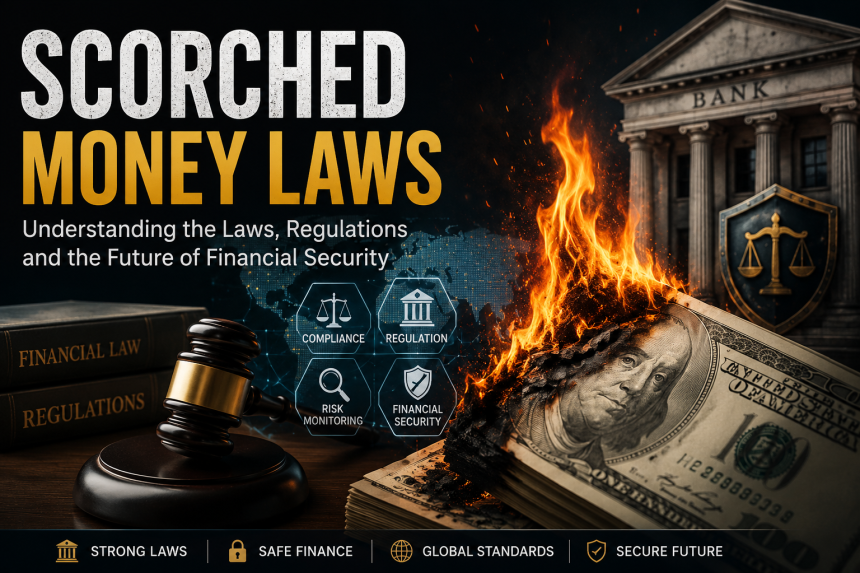
In modern financial systems, the idea of scorched money laws represents a broader discussion around how governments, regulators, and institutions respond to unstable, high-risk, or compromised financial activity. While the phrase itself is not a formal legal term, it can be used to describe strict regulatory frameworks that come into effect when money flows become suspicious, corrupted, or associated with illegal activity. These laws are deeply connected with financial oversight, compliance systems, and global economic stability.
Across the world, laws governing money are becoming increasingly strict as digital transactions, cryptocurrencies, and cross-border payments expand. The purpose is not only to control financial crime but also to protect economies from collapse caused by unregulated or harmful financial behavior.
What Are Scorched Money Laws in Financial Systems?
The concept of scorched money laws can be understood as a metaphor for extreme financial regulation triggered when money is considered “contaminated” or linked with illegal or high-risk activity. In such cases, financial authorities often take aggressive steps such as freezing assets, blocking accounts, or imposing strict compliance checks.
These frameworks are rooted in traditional laws related to anti-money laundering (AML), counter-terrorism financing (CTF), and fraud prevention. When financial systems detect suspicious activity, they essentially “burn away” the risk by isolating or removing the money from circulation.
In many countries, these measures are supported by banking regulations, central bank policies, and international agreements. The idea is simple: once money is suspected of being involved in illegal activity, it is treated as toxic to the system.
The Purpose Behind Strict Financial Laws
Financial systems rely heavily on trust. Without trust, banks, governments, and markets cannot function effectively. This is where strict laws come into play. Scorched money laws, in a conceptual sense, exist to maintain this trust.
The main goals include:
- Preventing money laundering activities
- Blocking funding for illegal operations
- Ensuring transparency in financial transactions
- Protecting national economies from instability
- Supporting international cooperation in financial investigations
These goals are enforced through regulatory bodies such as financial intelligence units, central banks, and international organizations. Every country develops its own version of financial laws, but they often share similar principles.
For example, banks are required to report large or suspicious transactions. Failure to comply with these regulations can result in heavy penalties or loss of banking licenses.
How Financial Systems Enforce Scorched Money Policies
Enforcement of scorched money laws is typically done through advanced monitoring systems. Banks and financial institutions use artificial intelligence, data analysis, and compliance software to track unusual activity.
When suspicious transactions are identified, several actions may occur:
- Temporary freezing of accounts
- Detailed audits of financial records
- Reporting to regulatory authorities
- Permanent blocking of funds in severe cases
These enforcement actions are supported by national and international laws that give regulators authority to act quickly. The speed of enforcement is crucial because financial crime often moves across borders within seconds.
In digital banking systems, enforcement has become even more automated. Algorithms can flag risky transactions instantly, allowing institutions to act before the money moves further.
The Role of Global Regulations and Cooperation
Financial crime is not limited to one country, which is why scorched money laws are often connected to global cooperation. Organizations such as the Financial Action Task Force (FATF) set international standards that countries are encouraged to follow.
These global laws and guidelines ensure that criminals cannot simply move money from one country to another to avoid detection. Instead, financial systems are increasingly interconnected.
Countries that fail to comply with international standards often face economic consequences, such as reduced foreign investment or restricted access to global banking systems. This creates strong pressure to maintain strict financial regulations.
Impact on Businesses and Individuals
While scorched money laws are designed to fight financial crime, they also affect legitimate businesses and individuals. Sometimes, transactions are flagged incorrectly, leading to delays or temporary account restrictions.
For businesses, compliance with financial laws means investing in proper accounting systems, transparency practices, and legal reporting structures. Small businesses, in particular, may find compliance challenging due to limited resources.
For individuals, especially those involved in international transactions, there may be additional verification steps. These include identity checks, source-of-funds documentation, and transaction monitoring.
Despite these challenges, these laws play an important role in maintaining economic stability and preventing fraud.
The Digital Economy and New Financial Challenges
With the rise of digital currencies, online banking, and decentralized finance, scorched money laws are evolving rapidly. Cryptocurrencies, in particular, have created new challenges for regulators due to their anonymity and cross-border nature.
Governments are now updating financial laws to address:
- Crypto exchange regulations
- Digital wallet compliance
- Blockchain transaction tracking
- Online fraud prevention systems
These updates aim to ensure that even decentralized systems remain accountable. However, balancing innovation and regulation remains a complex task.
Too much restriction can slow technological growth, while too little oversight can increase financial risk. Therefore, policymakers continuously refine laws to adapt to new financial technologies.
Ethical Considerations and Economic Debate
The concept of scorched money laws also raises ethical questions. Some critics argue that overly strict regulations can lead to financial exclusion, where individuals or businesses lose access to banking services due to minor compliance issues.
Others believe that strong laws are necessary to protect society from organized crime, terrorism financing, and large-scale fraud.
This debate continues among economists, policymakers, and legal experts. The challenge is finding a balance between financial freedom and security.
In some cases, governments are now introducing appeal mechanisms where individuals can challenge financial restrictions if they believe they were applied unfairly.
Future of Financial Regulation
The future of scorched money laws is likely to involve even more automation, artificial intelligence, and global coordination. Financial institutions are investing heavily in predictive systems that can identify risks before they fully emerge.
We can expect future financial laws to focus on:
- Real-time transaction monitoring
- Global unified compliance systems
- AI-driven fraud detection
- Stronger digital identity verification
- Cross-border regulatory cooperation
As financial systems become more complex, the need for adaptive and intelligent regulation will continue to grow.
Ultimately, the goal is to build a system where money flows freely but safely, without enabling illegal activity or systemic risk.
Conclusion
Scorched money laws represent a powerful metaphor for the strict financial controls used in modern economies to manage risk, prevent crime, and maintain trust in financial systems. These rules, supported by evolving financial laws, ensure that suspicious or harmful money is identified and isolated before it can damage the broader economy.
As technology advances and global financial networks expand, these regulations will continue to evolve. The challenge for the future will be balancing security with freedom, ensuring that financial systems remain both safe and accessible.
In the end, scorched money laws are not just about punishment or restriction. They are about preserving the integrity of global finance and ensuring that every transaction operates within a framework of trust, accountability, and strong financial laws.