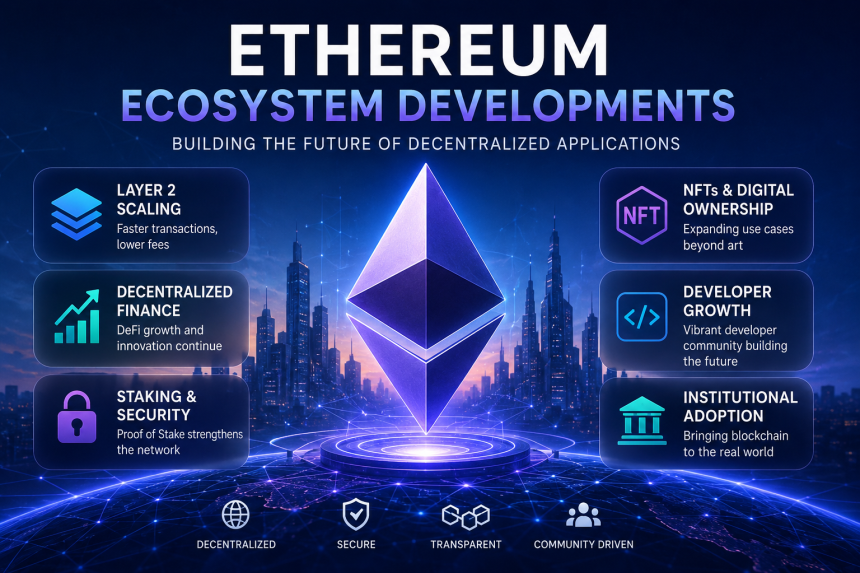
The blockchain industry continues to mature, and among all networks, Ethereum remains at the center of innovation, infrastructure growth, and decentralized application expansion. Understanding Ethereum ecosystem developments is essential for anyone tracking the future of decentralized finance, smart contracts, and Web3 applications. Over the past several years, the network has evolved far beyond its original use case, becoming a foundational layer for digital assets, financial protocols, and on-chain services that now operate at a global scale.
At the same time, interest in Ethereum has continued to grow among developers, institutions, and retail users. This growth is not accidental. It is the result of continuous technical upgrades, expanding developer tools, and a rapidly diversifying ecosystem that now supports everything from decentralized exchanges to gaming platforms and identity solutions.
Ethereum ecosystem developments and the shift toward modular scalability
One of the most significant Ethereum ecosystem developments in recent years has been the shift toward modular scalability. Instead of relying solely on the main chain to process all transactions, the network has increasingly embraced Layer 2 solutions. These include optimistic rollups and zero-knowledge rollups, which allow transactions to be processed off-chain while still benefiting from Ethereum’s security model.
This approach has dramatically improved transaction speed and reduced costs, which were once major barriers to adoption. Platforms built on top of Ethereum can now handle significantly higher volumes of activity without congesting the base layer.
As Ethereum continues to evolve, modular design is becoming a defining feature of its architecture. Developers are no longer limited by the constraints of the base chain. Instead, they can choose specialized scaling solutions that best fit their application requirements, whether that involves high-frequency trading, gaming, or decentralized social networks.
Growth of decentralized finance within Ethereum ecosystem developments
Decentralized finance remains one of the most influential sectors within the broader Ethereum ecosystem developments landscape. Lending protocols, decentralized exchanges, and yield platforms have all been built primarily on Ethereum due to its robust smart contract capabilities.
Over time, DeFi has shifted from experimental applications to more structured financial systems. Liquidity pools now manage billions in assets, and automated market makers have become a standard mechanism for token trading.
The evolution of Ethereum has played a central role in this transformation. Its programmability allows developers to design complex financial instruments without relying on traditional intermediaries. This has opened access to financial services for users who may not have access to conventional banking systems.
However, as DeFi expands, so do concerns around risk management, protocol security, and regulatory oversight. These challenges are also shaping new Ethereum ecosystem developments, particularly in areas such as decentralized insurance and on-chain identity verification.
Ethereum ecosystem developments in staking and network security
Another major milestone in Ethereum ecosystem developments is the transition to proof-of-stake consensus. This shift has fundamentally changed how the network is secured and how participants engage with it.
Instead of relying on energy-intensive mining, Ethereum now allows users to stake their assets to help validate transactions and secure the network. This mechanism has significantly reduced energy consumption while introducing new economic incentives for long-term participation.
Staking has also created a new layer of financial opportunity. Users can earn rewards by contributing to network security, and staking pools have emerged to make participation more accessible to smaller holders.
As staking continues to grow, it is influencing broader Ethereum ecosystem developments, including liquidity staking derivatives and staking infrastructure providers. These innovations are making the ecosystem more efficient, but they also introduce new dependencies that must be carefully managed.
Expansion of NFTs and digital ownership systems
Non-fungible tokens have played a critical role in shaping public awareness of blockchain technology, and they remain an important component of Ethereum ecosystem developments. NFTs allow users to represent ownership of digital and physical assets on-chain, creating verifiable scarcity and provenance.
Initially popular in art and collectibles, NFTs have expanded into gaming, music, ticketing, and even real estate tokenization. This diversification shows that Ethereum is not limited to financial applications but is also becoming a broader infrastructure for digital ownership.
While NFT market cycles have fluctuated, the underlying technology continues to evolve. Developers are now focusing on utility-based NFTs that provide access rights, membership benefits, and interactive experiences rather than purely speculative value.
This shift is helping stabilize the sector and integrate NFTs more deeply into long-term Ethereum ecosystem developments.
Developer activity and infrastructure maturity
A key indicator of the health of any blockchain ecosystem is developer activity, and in this area, Ethereum ecosystem developments continue to lead the industry. Thousands of developers actively contribute to open-source projects, protocol upgrades, and decentralized applications built on Ethereum.
The availability of developer tools, documentation, and software libraries has significantly improved over time. This has lowered barriers to entry and enabled faster innovation cycles.
As Ethereum matures, infrastructure providers such as node services, indexing platforms, and smart contract auditing firms are also becoming more sophisticated. These supporting layers are essential for ensuring reliability, scalability, and security across the ecosystem.
In addition, cross-chain interoperability is becoming a major focus. Developers are increasingly working on solutions that allow Ethereum-based applications to communicate with other blockchain networks, further expanding the reach of the ecosystem.
Institutional adoption and real-world integration
Institutional interest has become a defining feature of recent Ethereum ecosystem developments. Financial institutions, technology companies, and even governments are exploring ways to integrate blockchain infrastructure into their operations.
Ethereum’s programmable nature makes it particularly attractive for tokenization of real-world assets. This includes bonds, real estate, and commodities that can be represented digitally and traded more efficiently.
As Ethereum gains institutional acceptance, regulatory clarity is also improving in some regions. This is encouraging more traditional financial players to experiment with blockchain-based settlement systems and custody solutions.
However, institutional adoption also brings stricter compliance requirements. This is influencing the design of new protocols within the ecosystem, particularly those focused on privacy, auditing, and identity verification.
Challenges shaping Ethereum ecosystem developments
Despite its growth, the Ethereum ecosystem developments landscape is not without challenges. Scalability remains a long-term concern, even with Layer 2 solutions in place. Fragmentation across multiple rollups can sometimes create liquidity and user experience issues.
Security is another ongoing priority. As the ecosystem grows, so does the attack surface for smart contracts and decentralized applications. Continuous auditing and improved development standards are necessary to mitigate risks.
Additionally, regulatory uncertainty continues to influence how projects are built and deployed. Developers must navigate varying legal frameworks across jurisdictions, which can impact innovation speed.
Even so, these challenges are actively shaping the next phase of Ethereum evolution, pushing developers toward more resilient, efficient, and user-friendly systems.
The future outlook of Ethereum ecosystem developments
Looking ahead, the trajectory of Ethereum ecosystem developments suggests continued expansion across multiple dimensions. Scalability improvements, deeper institutional integration, and enhanced user experiences are all expected to play major roles.
The ecosystem is also likely to become more modular, with specialized layers handling execution, data availability, and settlement independently. This will allow Ethereum to support far greater levels of global demand without compromising decentralization.
As adoption increases, Ethereum’s role as a foundational layer for Web3 applications will likely strengthen further. From finance to gaming to identity systems, its influence continues to expand across digital infrastructure.
In conclusion, Ethereum ecosystem developments reflect a rapidly evolving network that is transitioning from an experimental blockchain platform into a core component of the global digital economy. As Ethereum continues to mature, its ecosystem will remain a central driver of innovation, shaping how value, data, and ownership are managed in the decentralized era.